Alpina
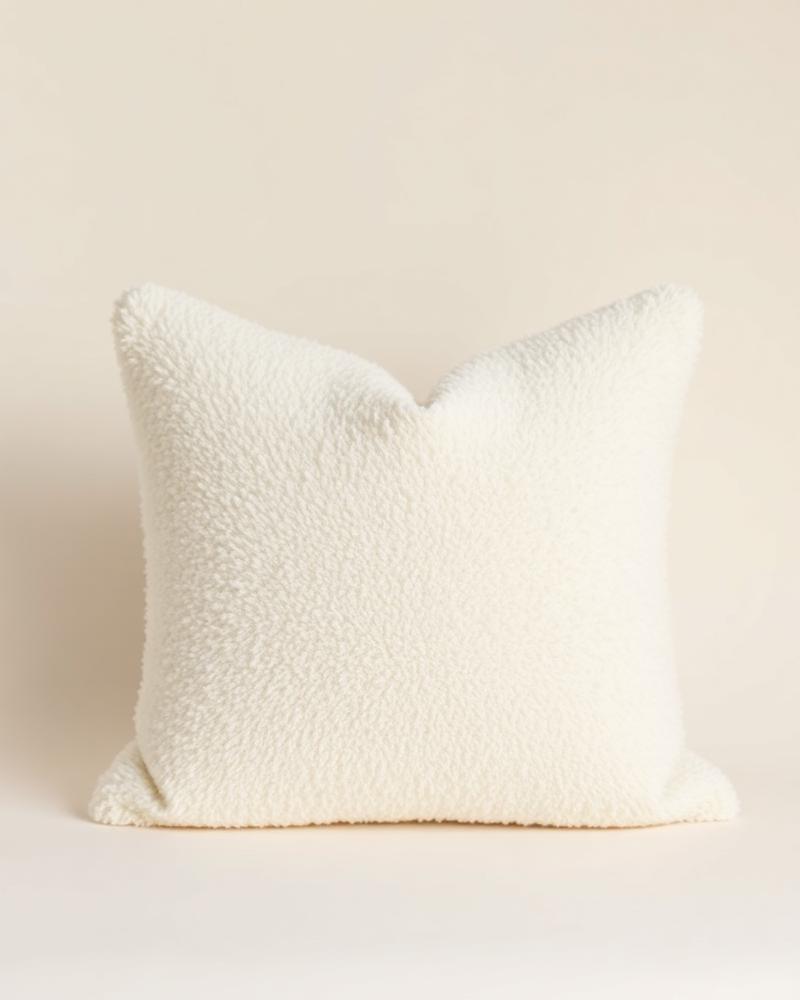
Bouclé Throw Pillow
$120
from $10/mo
Styling Tools
Arranging throw pillows requires more than intuition. It demands consideration of scale, proportion, and visual rhythm—qualities that distinguish a composed room from one that feels arbitrary. The pillow arrangement on your sofa establishes a room's tone, anchoring the eye and offering tactile invitation. Understanding dimension, count, and placement allows you to layer texture and pattern with intention, creating arrangements that feel both deliberate and effortlessly refined.
Recommended
5 pillows
5 pillows — 22in corners, 20in inners, one 12x20 lumbar centred
On a standard 84in sofa, work outside in: the largest pillow anchors each corner, a mid-size sits inside it, and a single lumbar breaks the symmetry in the centre.
Quick Answer
Begin with symmetry or asymmetry based on your sofa's architecture. Use odd counts (three, five) for casual balance or even counts (four, six) for formal symmetry. Anchor corners with 22x22-inch pillows, add 20x20-inch squares or 12x20-inch lumbars at center, and finish with 18x18-inch accent pillows for layered dimension. Insert size matters: choose inserts two inches larger than covers for proper fill.
Editorial guide
6 min read · Mont Rose Design Studio
01
The question of odd versus even counts hinges on formality. Even numbers—four or six pillows—create mirrored symmetry that suits traditional interiors and structured upholstery. Odd numbers—three, five, or seven—produce asymmetrical tension that reads as more relaxed and contemporary. A standard three-seat sofa typically holds four to six pillows comfortably, while loveseats accommodate two to three.
Count also depends on sofa length. An 84-inch sofa manages five to six pillows without crowding; a 72-inch frame holds four comfortably. Reserve seven-pillow arrangements for sectionals or sofas exceeding 96 inches. The goal is visual abundance without impeding function. If guests must remove more than two pillows to sit, the arrangement has overreached.
02
Three core sizes form the foundation of most arrangements. The 22x22-inch square provides substantial presence at sofa ends or corners, anchoring the composition with scale. The 20x20-inch square offers slightly softer volume, suitable for layering in front of larger pillows or centering on smaller frames. The 12x20-inch lumbar introduces horizontal relief, breaking the repetition of squares while supporting the lower back.
The 18x18-inch accent pillow functions as a finishing layer, typically placed in front of larger squares to add pattern or textural contrast. Reserve 24x24-inch pillows for oversized sectionals or deep-seat sofas with backs exceeding 36 inches. Proportion matters: pillows should not exceed two-thirds of the sofa back height. Our Throw Pillows collection addresses these dimensional standards with precision-cut forms that maintain their architecture over time.
03
Symmetrical arrangements mirror left and right, producing calm, formal balance. The classic four-pillow formula places matching 22x22-inch squares at each end, with two 12x20-inch lumbars centered between them, oriented horizontally. This configuration suits tailored interiors and sofas with tight backs. Alternatively, position four 20x20-inch squares in identical pairs, graduating pattern intensity from outer to inner.
A six-pillow symmetrical arrangement layers depth: place 22x22-inch pillows at corners, 20x20-inch squares inside those, and two 12x20-inch lumbars at center. This formula works well on sofas 90 inches or longer. For maximum formality, maintain identical fabric on mirrored pairs, varying only the center lumbar. Explore refined symmetrical options in our Living Room Throw Pillows, where coordinated sets simplify specifying.
04
Asymmetry introduces visual movement without chaos. A five-pillow asymmetrical arrangement might position a 22x22-inch pillow at the left corner, a 20x20-inch square beside it, a 12x20-inch lumbar at center, then reverse the scale on the right with an 18x18-inch accent and a 20x20-inch square. The imbalance creates energy while maintaining overall equilibrium through distributed visual weight.
Three-pillow arrangements offer the simplest asymmetry: one 22x22-inch pillow at one end, a 12x20-inch lumbar at center, and a 20x20-inch or 18x18-inch pillow at the opposite end. This spare approach suits minimal interiors and allows upholstery to remain visible. Asymmetry permits more adventurous pattern mixing, as the lack of mirroring reduces the risk of excess. Consider natural-fiber options from Linen Textiles and Organic Textures for arrangements that layer materiality rather than relying solely on print.
05
Sectionals demand zone-based thinking. Treat each section—left arm, corner, right arm, chaise—as its own vignette while maintaining material or color threads throughout. An L-shaped sectional might hold two 22x22-inch pillows on the three-seat side, one 20x20-inch and one lumbar at the corner, and two 20x20-inch pillows on the shorter return. Avoid placing pillows on chaise longues where bodies recline; instead, position a single lumbar at the chaise back if the frame allows.
Loveseats, typically 58 to 64 inches wide, require restraint. Two pillows—matching 20x20-inch squares or one 22x22-inch with one 12x20-inch lumbar—suffice. Three pillows crowd loveseats unless frames exceed 66 inches. Proportion becomes critical at smaller scale: oversized pillows visually consume compact frames, making the piece feel cluttered rather than appointed. For additional layout variations and styling context, reference our Decorative Pillow Arrangement Ideas.
06
Insert dimensions determine whether a pillow reads as crisp or collapsed. The standard rule: choose inserts two inches larger than the cover. A 20x20-inch cover requires a 22x22-inch insert; an 18x18-inch cover needs a 20x20-inch insert. This sizing ensures corners fill completely and seams remain taut, producing the plump, tailored look characteristic of luxury interiors.
Fill composition affects both appearance and longevity. Down-and-feather blends (9010 or 955 ratios) offer the softest hand and natural resilience, though they require periodic fluffing. Synthetic down-alternative inserts maintain shape with less maintenance and suit households with allergies. Avoid loose polyester fill, which clumps and flattens within months. Proper insert quality matters as much as cover fabrication—underinvestment here undermines even the finest textiles.
07
Successful pattern mixing relies on scale variation and tonal discipline. Combine one large-scale print, one medium geometric or stripe, and one textural solid or small motif. Limit the palette to three or four colors, allowing one to dominate while others accent. A common misstep is combining patterns of similar scale, which compete rather than converse. A 6-inch damask, a 1-inch stripe, and a solid linen in coordinating tones produce harmony; three florals at 4-inch scale create visual noise.
Texture can substitute for pattern entirely. Pairing a bouclé pillow with flat linen and a subtle slub weave generates interest without graphic complexity. This approach suits interiors where architecture or art commands attention and pillows serve as supporting elements rather than focal points. For detailed guidance on balancing prints, scales, and material finishes, consult our How To Mix Throw Pillow Patterns, which addresses common proportional errors and offers fabric-pairing frameworks used by our design studio.
A standard three-seat sofa accommodates four to six throw pillows comfortably. Loveseats hold two to three, while sectionals may require six to eight depending on configuration. The count should provide visual fullness without forcing guests to remove more than two pillows to sit. Odd numbers suit casual, asymmetrical arrangements; even numbers create formal symmetry. Sofa length and back height also dictate capacity—frames under 72 inches rarely support more than four pillows without crowding.
Standard sofas pair 22x22-inch and 20x20-inch square pillows as foundations, with 12x20-inch lumbars for horizontal contrast and 18x18-inch accent pillows for layering. A typical arrangement uses 22x22-inch pillows at corners, 20x20-inch squares inside those, and a lumbar at center. Pillow height should not exceed two-thirds of the sofa back height. Deeper seats and taller backs can accommodate 24x24-inch pillows, while loveseats perform best with 20x20-inch squares or smaller.
Throw pillows need not match exactly but should share a cohesive thread—color family, material type, or tonal range. Matching pairs at sofa ends with varied centers works for symmetrical arrangements. Asymmetrical layouts permit greater diversity but benefit from limiting the palette to three or four colors and varying pattern scale rather than introducing unrelated prints. Texture alone can create cohesion: bouclé, linen, and slub weaves in neutral tones produce collected refinement without literal matching.
Lumbar pillows are positioned at the sofa center, oriented horizontally, to provide lower-back support and break the visual repetition of square pillows. In symmetrical arrangements, a single lumbar sits between mirrored square pairs. In asymmetrical layouts, the lumbar often anchors the center while squares vary in size toward the ends. On sectionals, place lumbars at corner junctions or at the back of chaise sections if the frame depth allows. Avoid layering lumbars in front of squares; they function best as standalone horizontal elements.
Treat each sectional zone—left arm, corner, right arm, chaise—as a distinct area while maintaining material or color continuity across the whole. An L-shaped sectional might hold two 22x22-inch pillows on the longer side, one 20x20-inch and one lumbar at the corner, and two 20x20-inch pillows on the return. Avoid placing pillows where bodies recline fully, such as chaise surfaces. Instead, reserve those for a single lumbar at the chaise back if desired. Distribute visual weight rather than mirroring exactly.
Keep reading